The surface is covered in a reflective coating, usually aluminum but sometimes silver or gold.
Parts of the surface reflect light well, others don't reflect it so well. The different regions (reflective versus non-reflective) are microscopic in size.
As the CD spins, these regions pass in front of a laser which reflects or not off the surface, and the light when it is reflected is picked up by a photocell which converts it to logic pulses.
These logic pulses represent numbers, which in turn represent a digitized form of the music, very much like a .WAV file on your computer. If you have ever used .WAV file editting software like Cool Edit or Goldwave, you probably have a pretty good idea of how different numbers can be strung together to form a sound on the computer -- a CD player is doing exactly the same thing. It is basically reading a great big .WAV file off the surface of the disk (just like your computer reads one from the hard drive) and plays it out.
The website linked by Mr-Know-It-All just above me is a very good explanation -- the part I think you will be most interested is this sub-page of it:
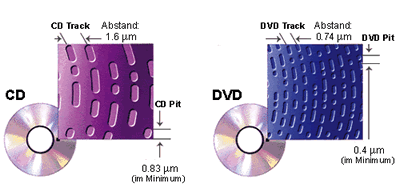
http://electronics.howstuffworks.com/cd5...Here is a good picture showing how the "pits" (non-reflective parts of the disc) look:
http://referate.mezdata.de/sj2003/cd_tho...When a laser spot shines on the surface, the spot is about twice as wide as the track of pits. If the spot is shining on a flat part of the surface, it is all reflected back and the photo-sensor "sees" the light. But if the spot is shining on one of the pits, some of the light is in the pit and some is not. The pit is a very precise depth (exactly one quarter of the wavelength of the light used, or about nine one-millionths of an inch deep) and due to a funny property of laser light, the part of the light reflected from the "surface" is canceled out by the part of the light reflected from the "pit" so the photo-sensor does not see any light. The website shows this as light being deflected away from the sensor by the "bumps" -- this is not exactly how it happens (it is based on the "destructive interference" of laser light which I just descibed) but it is close enough and probably a lot easier to understand.
Here is more information on how the discs themselves are manufactured:
http://www.ee.washington.edu/conselec/CE...